Shifting focus
Stress Resilience Retraining Practice — part 3: A mini-vacation from stress

This is part three of a four-part series exploring each step of the Stress Resilience Retraining Practice. I originally developed it to help people with complex trauma retrain their nervous systems. But it’s also remarkably useful for anyone navigating chronic stress, especially if you feel stalled by fear, anger, overwhelm, perfectionism, procrastination, or self-doubt.
The four steps of Stress Resilience Retraining Practice are:
Focus on the physical (this article)
Step three is all about taking a short, powerful mini-break—not by escaping the stress, but by redirecting your attention in a way that calms the body while retraining the brain.
Honestly? It’s a bit of a miracle.
Brief review
As always, it’s a good idea to approach this (and everything, really) with curiosity, playfulness, and non-judgment. And just to be clear: we do all these steps while tapping and breathing.
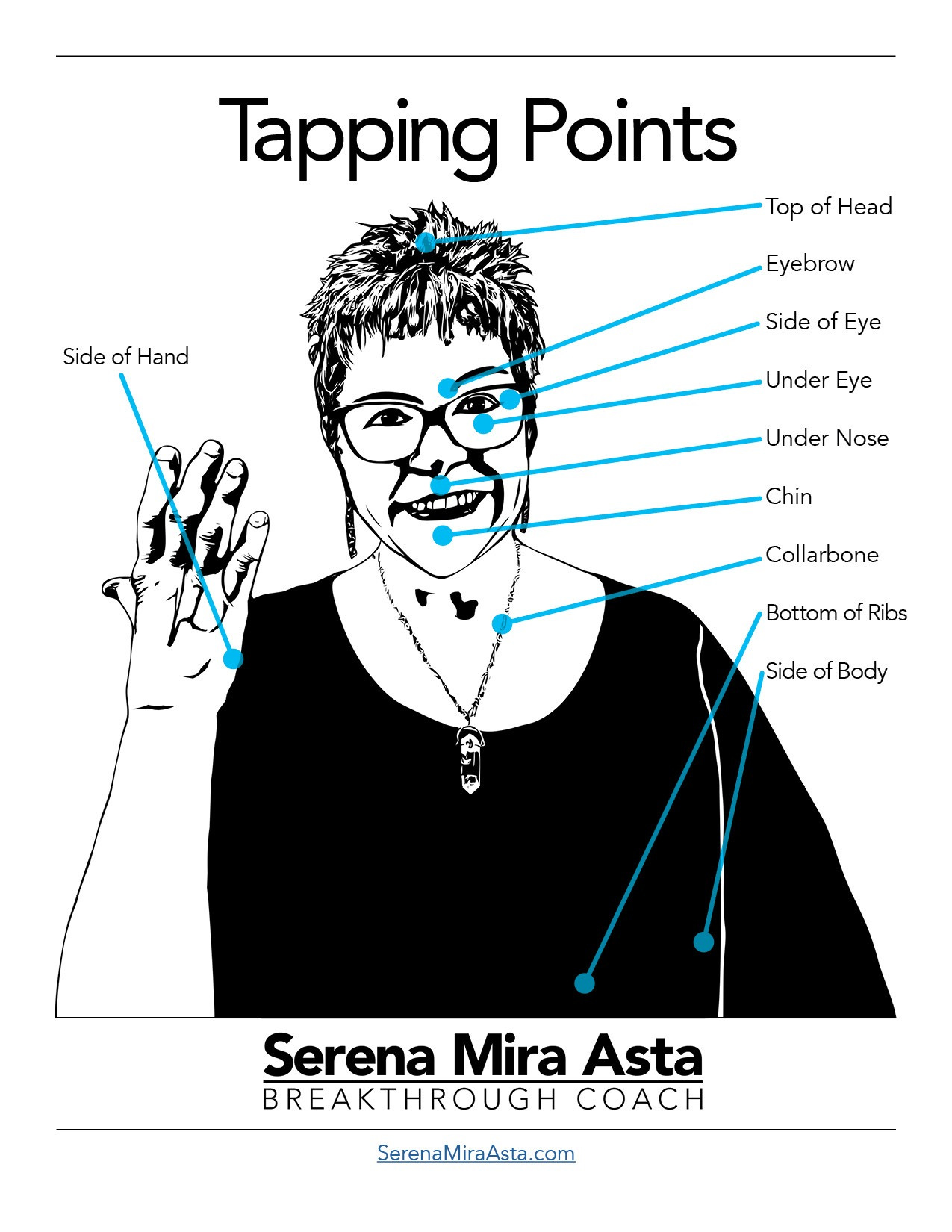
(If you’re not familiar with tapping, there’s a handout and some training below.)
The first two steps of this practice lay a foundation for step three.
Step 1: Notice the stress
Observe your current experience using clear, neutral terms. This morning, my observation was:
“I am sad, anxious, and tired.”
Step 2: Untangle the stress feelings
Acknowledge that your stress is partly shaped by past experiences. It convinces you to believe:
“I’m small. I’m alone. I can’t cope.”Then your body joins in, convincing you that:
“I’m under an actual physical attack (like by a tiger).”Next, gently acknowledge:
“I’m different now than I was back then (as a child). There are no tigers here.”
These steps shift you into a witnessing state—without trying to fix or avoid anything. It opens the door to the upcoming lovely mini-vacation from stress.

Step 3: Shift focus
While you continue to tap and breathe in this practice, gently:
Put your stress feelings aside—just for now
Imagine placing them on a shelf, in your phone, or somewhere nearby.
You’re not erasing or denying (or feeding) them. You’re simply setting them down so your system can rest.
Don’t worry – you can pick ‘em up again soon.
Shift focus from “stress feelings” to “physical feelings”
I mean this quite literally. Focus all your awareness into the sensations caused by fingers tapping and breath flowing.
Engage your curiosity
Ask playful questions that draw your attention deeper into your body. These “curiosity cues” make it easier—and even enjoyable—to focus on the percussive sensation of tapping in your bones and muscles.
Examples
How does this spot feel? Springy? Soft? Hard? I take a breath...
Do I like tapping a little higher? Lower? I take a breath...
If I shift slightly, does the percussion change? I take a breath...
What does this spot feel as it receives my tapping? I take a breath...
You can be as serious or as silly as you like.
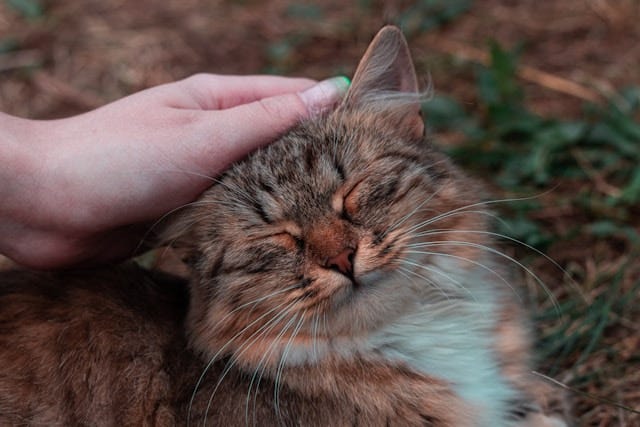
Think of it as giving your body the kind attention you’d give a beloved pet.
Most of us never do this. But when you do, your body may “purr” with connection.
My favorites
Here are my go-to questions to explore while tapping and breathing — feel free to make up your own. The more interesting and playful, the more you’re freed to fully experience the physical.
Top of the head: Feel how hair follicles bounce as you move your fingers around your crown.
Eyebrow point: Notice how soft your eyebrows feel to your fingertips.
Side of the eye: Explore the edge of the ocular orbit bone (it’s just fun to say!), then slightly move backward toward the temple.
Under the eye: Try the cheekbone versus the soft cheek below.
Under the nose: This is the philtrum—a funny little ridge with no current purpose (and is also fun to say!). Compare the ridges and center groove.
Under the mouth: Wrap your lower lip over your teeth. Tap gently and see if vibration moves into your jaw, neck, or shoulders.
Collarbone: Find a bone, then soft tissue just below, then move to the center of the chest over the thymus. Notice what feels good and hang out there.
Front of lower ribcage: Check out the lowest rib on either side.
Side of the body: The ribcage extends farther than you think—let yourself be fascinated.
Why this works
By tapping, breathing, and using curiosity to maintain a gentle yet intense focus, you’re doing three powerful things:
Redirecting your mind from stressful thoughts to sensory awareness
Engaging your body in rhythmic movement and stimulation
Integrating both through mindful curiosity
This combination…
Interrupts the loop of stress hormones
Activates brain regions for calm and regulation
Grounds you in the here and now (vs. past or future stress)
Brings immediate physical relief (yawning, sighing, and tension release are common)
Boosts calming neurochemicals: dopamine, oxytocin, serotonin, GABA, and endorphins
Rebuilds trust and connection with your own body—a powerful form of reparenting, especially if you didn’t receive this kind of attuned physical attention in childhood
Final thoughts
This is the most effective and simple skill combo I’ve ever used. It interrupts the stress response and retrains the nervous system—and only takes a couple of minutes once you learn it.
Next week, I’ll explore the final piece of this process:
Step Four: Inviting internal wholeness—where you begin to embody your full, expansive self.
The you that was never broken.
The you that is always whole.
The you that remains connected to all good things.
Isn’t this cool?
Learn to tap!
Check out my article What is tapping? for more details including research, tap along videos, and documentaries, (under the Resources tab if you need to find it again later ).
I’ll add training videos soon!
Sources and further reading
Church, D., Yount, G., & Brooks, A. J. (2012b). The effect of emotional freedom techniques on Stress biochemistry. The Journal of Nervous and Mental Disease, 200(10), 891–896. (Findings showed a 24% reduction in cortisol levels after a single EFT session.)
Bach, D., Groesbeck, G., Stapleton, P., Sims, R., Blickheuser, K., & Church, D. (2019b). Clinical EFT (Emotional Freedom Techniques) improves multiple physiological markers of health. Journal of Evidence-Based Integrative Medicine, 24. (This review found EFT to be a highly effective treatment for anxiety across multiple physical markers of health.)
Stapleton, P., Kip, K., Church, D., Toussaint, L., Footman, J., Ballantyne, P., & O’Keefe, T. (2023). Emotional freedom techniques for treating post traumatic stress disorder: an updated systematic review and meta-analysis. Frontiers in Psychology, 14. (This recent meta-analysis supports EFT's efficacy in reducing PTSD symptoms.)
Stapleton, P., Crighton, G., Sabot, D., & O’Neill, H. M. (2020). Reexamining the effect of emotional freedom techniques on stress biochemistry: A randomized controlled trial. Psychological Trauma Theory Research Practice and Policy, 12(8), 869–877. (Findings showed a 43% reduction in cortisol levels after a one hour of group EFT tapping.)
Porges, S. W. (2011). The Polyvagal Theory: Neurophysiological Foundations of Emotions, Attachment, Communication, and Self-Regulation. W. W. Norton. (Introduces the polyvagal framework, explaining how physiological safety supports emotional regulation.)
Siegel, D. J. (2010). The Mindful Therapist: A Clinician’s Guide to Mindsight and Neural Integration. New York: W. W. Norton & Company. (Discusses how curiosity, presence, and integration enhance healing and stress resilience.)
Church, D. (2017). The EFT manual. Hay House, Inc. (A foundational guide to Emotional Freedom Techniques, offering practical tapping sequences.)
McGonigal, K. (2015). The upside of stress: Why stress is good for you (and how to get good at it). Random House. (Reframes stress as a potential source of resilience and growth, especially when approached with meaning and curiosity.)
van der Kolk, B. A. (2014). The body keeps the score: Brain, mind, and body in the healing of trauma. Viking. (Explores how trauma is stored in the body and how body-based therapies support recovery.)